

Makgeolli Brewer: Become a Local Crew on Weekends in Paju, Korea
South Korea · Paju
Select a period
Estimated amount
- Period (A total of 3 times on the weekend (each for 1 night and 2 days))+ ₩170,000
Project introduction
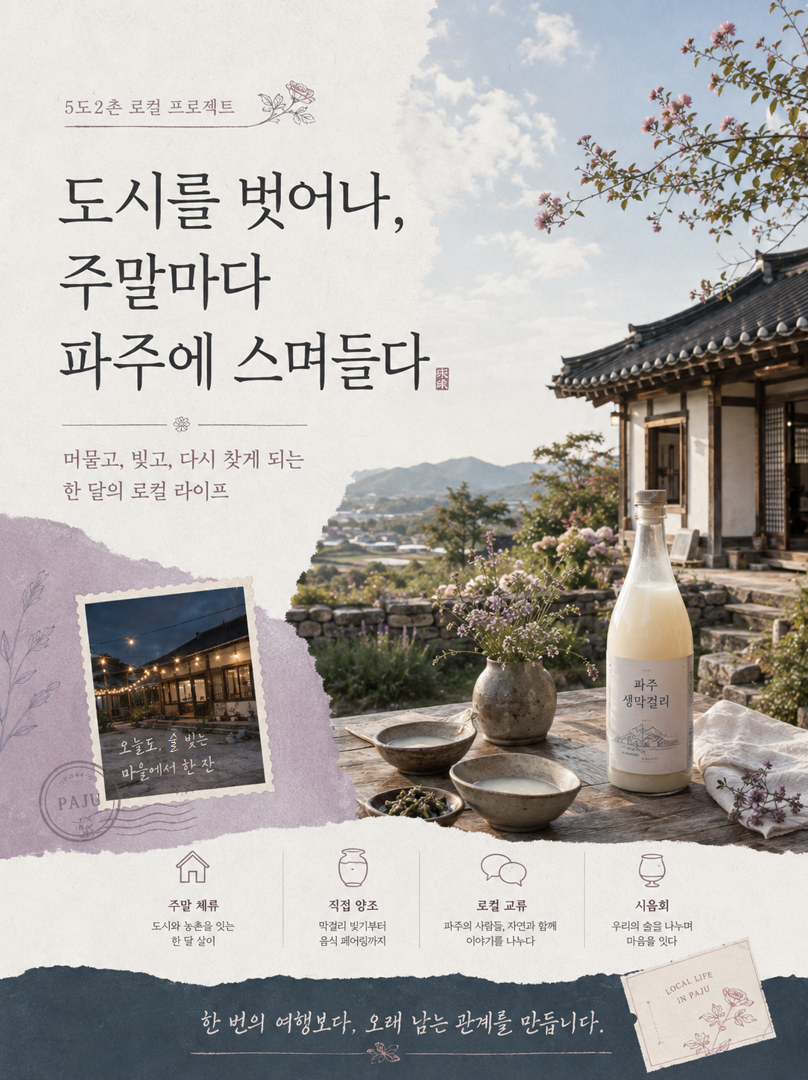
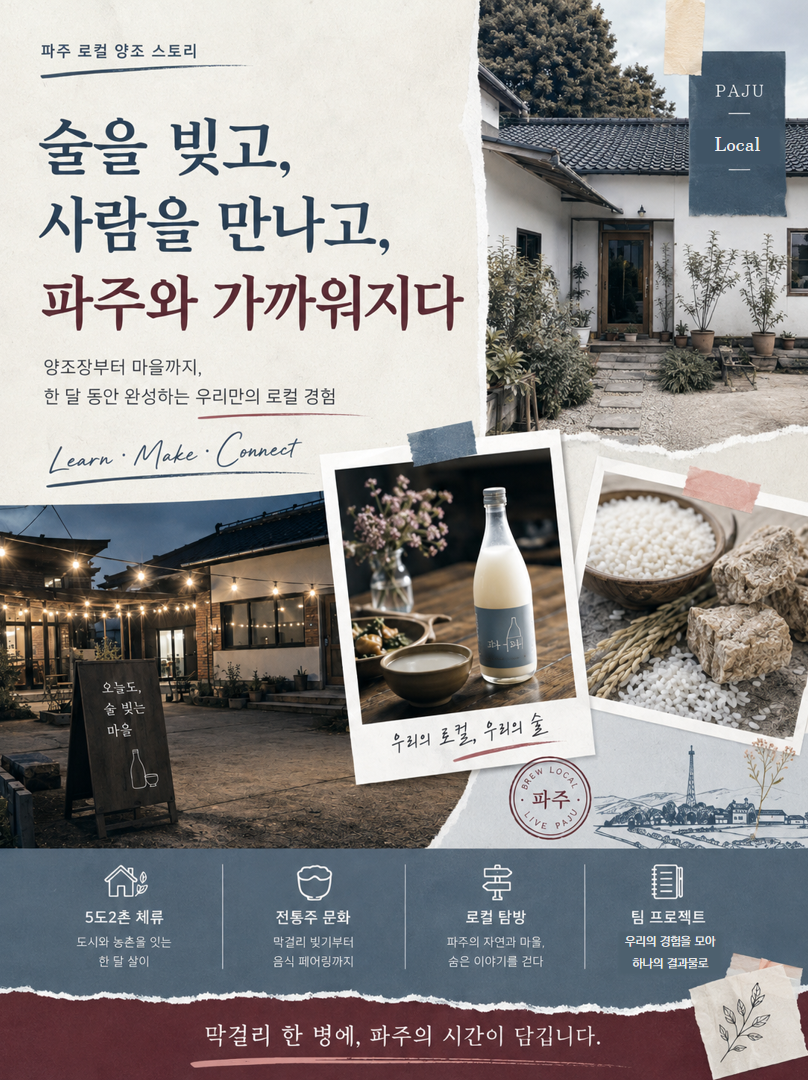
On weekdays, I live in the city, and on certain weekends, I experience new daily life in Paju. This project is not just a quick trip, but it focuses on Paju's local breweries.We brew alcohol, stay together, and meet local people and places repeatedly to create my own 'second neighborhood'. This is a 5do 2chon local project.
First, we learn the basics of makgeolli and decide on the concept of taste, alcohol content, and color in teams. Then we brew the alcohol ourselves and complete our team's unique makgeolli by tasting it together. At the healing farm, we connect with Paju's nature, and at the guesthouse, we share stories and enjoy the fire. In the end, we showcase the alcohol we made at a flea market tasting event.During three weekends,participants become 'weekend local crews' who form a relationship with Paju, going beyond just being tourists.
1. Set aside your usual self on weekdays and live a different daily life in Paju every weekend.
Take a break from your repetitive commute and familiar city scenery, and head to Paju.Here, it's not just a trip to rest and return; you brew alcohol, stay together, and meet new people.You can spend a day at a slower pace than usual and experience a lifestyle different from the city.
At first, the roads and spaces of Paju may feel strange, but after visiting several times, they naturally become familiar. When you greet the people you meet again and wait to see how the alcohol we made changes, Paju soon becomes a place you want to revisit instead of just a 'once-visited destination'.
Three weekends spent in Paju is not just an ordinary travel schedule.It is my second daily life experienced outside the city.You spend a slightly slower morning, create something yourself, and see new sights that are hard to find usually. These weekends spent at a different pace bring new changes to the routine.
2. Instead of a weekend to rest and return, spend a weekend 'completing our team's makgeolli'.
This project does not just end with an experience of making makgeolli following a set recipe.First, we learn the principles of how makgeolli is made and its fermentation process. Then, we discuss with team members what kind of taste, alcohol content, and color we want to create and decide on our team's concept.
When the first makgeolli ferments, we taste it together to check how its flavor has changed. After discussing what we liked and what we want to change with the team, we incorporate that feedback into the next brewing. Through the process of making, waiting, tasting, and brewing again, our team's unique makgeolli gradually takes shape.
Finally, we introduce the completed alcohol at a flea market tasting event.We also see how people react when they taste our alcohol.From the moment we decided on the concept to the moment we showcase the finished alcohol, we participate directly, which makes it much more memorable than a simple experience.
3. Instead of just learning about alcohol, meet people and spaces to shape Paju's story together.
The project is not only held inside the brewery.At the healing farm, we closely observe and experience herbs and plants to get ideas for the alcohol we will make. At the guesthouse, we share meals and talk. While enjoying the fire, we naturally share our daily lives and reasons for joining the project.
In the end, we showcase the makgeolli we made to the townspeople and share the stories we experienced during the project.Meetings that started to make alcohol develop into relationships that connect people to people and travelers to the local area.
What this project leaves behind is not just a bottle of makgeolli. You also have the experience of revisiting the same region, greeting people you met again, and sharing the things you created. You start as a traveler, but by the end of the project, you have a reason to want to return to Paju.Be a 'weekend local crew' in Paju.
Project activities
This is the 5do2chon project where we escape from the city's daily life and stay in Paju every set weekend. We brew alcohol ourselves and meet local people and spaces several times. This isn't just a trip that ends after one experience; instead, we create our own 'second daily life' in Paju through three meetings and the brewing process.
The focus of the project is the process of completing our team's unique makgeolli.
After learning about how makgeolli is made and the fermentation process, we decide on the concept of our alcohol based on taste, aroma, alcohol content, and color with team members. Then, we brew the first batch of makgeolli ourselves. Once fermentation is done, we taste it together to check the flavor changes and share our thoughts. Based on this experience, we challenge ourselves to brew a second batch.
Outside the brewery, we experience various local spaces in Paju. At a healing farm, we meet herbs and plants and get new ideas, and at a guesthouse, we share meals and stories around a fire. At first, the participants feel unfamiliar, but as they brew alcohol together and spend time together, they naturally grow closer. Becoming one 'weekend local crew' is an important experience of this project.
At the end, we participate in a tasting event where we showcase the makgeolli made in the village. We share the alcohol we've brewed and the stories behind it with local residents. We finish the project by seeing how people feel about our drink.
A bottle of makgeolli holds the memories of the weekends spent together in Paju.
While waiting for the rice and yeast to turn into alcohol, we get closer to others, and the once-unfamiliar Paju becomes a place we want to visit again. With a bottle of makgeolli, create your own special weekend and a 'second neighborhood' in Paju.
■ Main Activities
"Making alcohol may be about making time."
As we wait for the rice and yeast to become alcohol, strangers turn into a crew, and the first-time visit to Paju becomes a place we want to return to. What we complete in this project is not just a bottle of makgeolli. The relationships and memories we create together, and our own second neighborhood also stay with us.
1) First round | A weekend meeting makgeolli and Paju for the first time.
We listen to explanations about the village and the project at a local brewery and form our teams. After learning the principles of how makgeolli is made and the basic brewing methods, we decide on the alcohol's alcohol content, taste, and color for our team. In the evening, we enjoy a welcome party and a makgeolli tasting at the guesthouse while breaking the ice and sharing around a fire. The next day, we return to the brewery to brew the first makgeolli as a team. This is the first weekend where the strangers and the unfamiliar Paju start to feel familiar.
2) Second round | A weekend connecting local inspiration to taste.
We visit a healing farm to see and experience herbs and plants. Based on this experience, we look for new ideas to put into our alcohol. Then we move to the brewery, taste our first makgeolli, and discuss with team members how the flavor changed. We also taste other local makgeolli to compare various flavors and aromas. The next day, based on our earlier experiences and opinions, we brew the second batch of makgeolli. This is the time when our team's desired flavor becomes clearer than before.
3) Third round | The final weekend showcasing the alcohol we made in Paju.
On the final weekend, we prepare a flea market and tasting event in the village. We set up the makgeolli we made and introduce it to visitors. During the tasting, we observe people's reactions to our drink, and the discussions and experiments turn into a completed result. After the event, we share our last meal with the crew and reflect on the past times. The next day, we share the tasting results and project outcomes, and receive a 'Paju Local Brewing Crew Certificate' from the village chief to wrap up the project.
* The detailed schedule may change based on project operations and local cooperation events. The flea market will be held as a local tasting event, not for commercial sales.
■ Additional Information
- A maximum of 12 people can participate in the project per team. Participants are expected to attend all three scheduled times.
- The main target participants are young people aged 19 to 39, both local and foreign. For foreign participants, preference will be given to those who can communicate smoothly in Korean since they need to participate in team meetings and collaborations.
- The makgeolli brewing experience will follow the safety and hygiene standards of local breweries. Participants will first receive safety training before joining the practical sessions.
- Costs for meals and the healing farm experience, which are not included in the project budget, will be covered by the participation fee.
- The exact operation dates, recruitment period, participation fees, personal items needed, and transportation details will be announced after final confirmation.
■ Program Schedule
| Parking | Location | Main Activities |
|
Week 1 Meet and brew |
Local brewery / Guesthouse |
Learn about makgeolli → Team formation → Concept planning → First brewing Introduction to the village and project · Team formation · Basic theory and training of makgeolli · Team concept planning for taste/alcohol content/color · First experimental brewing · Makgeolli tasting · Ice-breaking & campfire time. |
|
Week 2 Taste and brew again |
Healing farm / Local brewery / Guesthouse |
Local exploration → First tasting → Feedback → Second brewing Herb and plant-based local experience · Explore brewing material ideas · First batch tasting and feedback · Taste local makgeolli · Second experimental brewing. |
|
Week 3 Complete and share |
Village / Local brewery / Guesthouse |
Local exploration → First tasting → Feedback → Second brewing Prepare for flea market and tasting event · Our team's makgeolli tasting · Interacting with local residents · Last dinner · Sharing tasting results · Paju Local Brewing Crew graduation ceremony. |
What's included
- 1Operations Staff
- 2Specialized Training in Makgeolli Brewing
- 3Accommodation Included (Check Details)
- 4Groceries / Ingredients Provided
- 524/7 Emergency Contact Support
- 6Orientation Materials
- 7Program / Travel Tips
- 8Wi-Fi / Internet Access
- 9Common Lounge & Shared Spaces
- 10Host Institution Certificate
- 11Equipment / Basic Training
- 12Local Support / Inquiries
- 13Korean Staff Support
- 14Project Supplies (Partial)
- 15Tutoring / Consulting
- 16Professional Training / Education
- 17Daily Meals (3 per day)
- 18Shower Facilities
- 19Basic Home Appliances Provided
■ Accommodation
- A total of 3 sessions, each lasting 1 night and 2 days, providing guest house lodging (separate for men and women / dormitory)
- A place for participants to network and hold evening campfires and team meetings.
■ Project Activities
- Traditional liquor theory training and makgeolli brewing practice.
- Basic ingredients and program materials needed for makgeolli brewing will be provided (teams need to prepare special materials separately).
- Experience healing farm herb and plant-based healing content and explore brewing ideas.
- Experience tasting at the coexistence flea market and receive feedback from local evaluations.
- Team-based makgeolli concept and branding process, plus support from project operation staff.
■ Exclusions
- Participation fee.
- Round-trip transportation.
- Other living expenses in the area (meals, transportation, etc.).
- Personal traveler insurance.
■ Certification and Outcomes
- ‘Paju Local Brewing Crew Certificate’ issued by the village leader / team results and concepts for makgeolli.
*It is recommended to make transportation reservations after the final schedule of the project is confirmed.
About the organization
This project's local brewing space is in a rural village in Paju. Here, we connect traditional liquor, agriculture, and local people and places to create new regional value.
Rural areas are losing vitality due to aging and a decrease in young people. Our goal is to create an environment where existing residents and young returnees can grow together. We connect farmers' long-time experiences with young people's new ideas, creating various programs and collaborations to increase the value of local agricultural products.
It doesn't end with just producing agricultural products. We connect traditional liquor, local lodging, rural experiences, cultural spaces, and local food into one journey. We run stay programs that use village guesthouses, farms, and cultural spaces so that visitors can stay, meet people, and experience real life instead of just looking around briefly.
We are also developing makgeolli that reflects Paju's local characteristics and creating experience content to turn the village's unique stories into a brand. We aim to build a sustainable structure where local agricultural products, people, and culture grow together and their value returns to the village. This is the vision of a local community we are shaping.
A place that goes beyond brewing alcohol to also shape relationships between people and the region.
Through the experience of mutual growth that started in Paju, we are creating a sustainable local future.
About the accommodation
During the project, we stay at a guest house. Each schedule is for 1 night and 2 days, and the accommodation is in dormitories separated by gender. This place is not just for sleeping. We have welcome parties, Korea rice wine tastings, ice-breaking activities, campfires, and the last meal together, creating a space where participants can naturally bond.
* The accommodation is in dormitories separated by gender, and room assignments and detailed amenities will be announced at the final briefing.
* The guest house and shared accommodations in the area may look different from the images.
City travel information
■ Location: Paju City, Gyeonggi Province
Paju, where the project takes place, is a city where you can experience local feelings of traditional liquor and countryside, along with peace, art, and nature all at once. Before and after the program schedule, explore Paju's main tourist spots to broaden your local weekend stay experience.
1. Heyri Art Village | A cultural village where art and taste meet
This is a representative cultural and artistic space in Paju, filled with galleries, museums, bookstores, small theaters, cafes, and workshop spaces. The buildings and alleys connect like a single exhibition, making it fun to walk slowly, see the exhibits, and discover spaces that match your taste. If you are a participant planning a makgeolli brand, this place is also great for inspiration on space branding and local content.
2. Imjingak Peace Nuri | A landscape of peace you can only find in Paju
This is a tourist spot that most symbolically shows Paju's local characteristics. You can walk around the vast Peace Nuri Park and the Imjingak area while facing the history of division and the meaning of peace. It offers a chance to deeply understand the stories of the city of Paju, making it a recommended place for both local and foreign participants, different from the usual nature or cafe trips.
3. Majang Lake | Natural healing by walking along the lake and forest
This is a representative natural tourist spot in Paju, featuring a 220-meter-long suspension bridge across the lake and about 4.5 km of lakeside walking paths. It's a great place to walk or relax while enjoying the lake and forest, making it suitable for leisurely enjoying Paju's nature after an intensive team project. The changing scenery with the seasons makes it attractive for weekend trips.
Schedule and fees
This project will take place over 3 sessions, each lasting 2 days and 1 night.
Total project: Up to 12 people / Participate in 3 designated weekends.
■ Target Audience and Qualifications
- Young people aged 19 to 39 who live in the city during the week and want to experience a new "cousin life" on the weekends.
- People who want to spend productive weekends that provide learning and results rather than just resting.
- People interested in planning traditional Korean rice wine, local brands, and similar topics.
- People who enjoy collaborating and interacting with local residents, young farmers, and participants from inside and outside the country.
- For foreign participants, those who want to deeply experience traditional Korean liquor and actual local village culture are preferred (ability to communicate in Korean is a plus).
How to apply
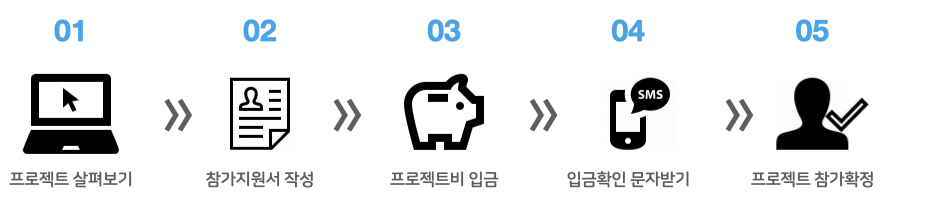
| 01Check out the project. |
- Check if there are specific participation dates or if you can join at any time that fits your schedule! - Read stories from people who have actually participated in this project! |
| 02Fill out the participation application. | - Don’t feel pressured; express yourself comfortably and honestly. |
| 03Deposit the project fee. |
- After the project registration fee or full payment is confirmed, the participant's application will be sent to the local agency. - (If needed) After the fee payment, there will be a Skype interview with the local agency to confirm your participation. - If the local agency does not approve after their review, 100% of the registration and participation fees will be refunded. |
| 04Get confirmation text for your deposit. |
- The day after a participant deposits the project fee, we will check and send a confirmation text. If you don’t receive a text the day after the deposit, please contact us! (For weekend deposits, confirmations will be done on Monday morning.) |
| 05Confirmation of project participation. |
- It takes about 1 to 7 days for the local agency to review the application before final confirmation. - Once you are finally accepted into the project, the person in charge will contact you separately. |
| 06Arrival and project start. |
- Participants will meet the person in charge and have a local orientation when they arrive. - After the local orientation, participants should learn the information provided by the local agency and start the project while keeping safety in mind. * The local orientation might not be carried out in some cases depending on the local agency, and it can change or be shortened based on circumstances. |
| 07 Submit feedback after the project. |
- After the project ends, participants should submit feedback, and a certificate will be issued after review. |